-- Soil Judging International Union of Soil Sciences (IUSS) --

Hello Students and Scientists

Welcome to International Soil Judging

Soil judging is a hands-on educational activity where participants evaluate soil profiles to classify soils, understand their properties, and make land use recommendations. This hub is dedicated to International Soil Judging contests organized under the International Union of Soil Sciences (IUSS), founded in 1924 as the global union of soil scientists. Explore past and upcoming events, courses, and more.

Resources & Downloads

📖 Materials for 2026 International Soil Judging Contest in Nanjing (China)*

Tailored materials developed from IUSS Templates and
specific one like FAQ, Handbook, Program, etc.

IUSS SJC Handbook for Nanjing 2026.05.29 (Includes Scoresheets and Regulations)
Program for IUSS International Soil Judging Contest Nanjing
IUSS SJ Nanjing Frequently Asked Questions - FAQ
Simplified versions of some WRB diagnostics
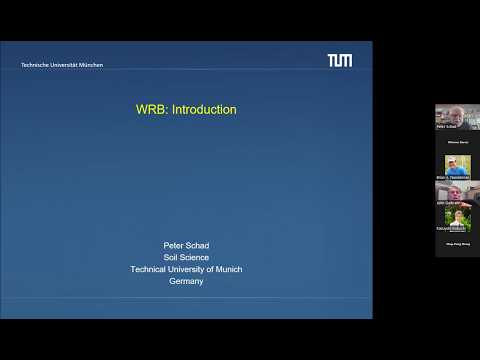
WRB Introduction — Dr. Peter Schad (Webinar slides)
Simplified definitions of diagnostic horizons ... Soil Taxonomy
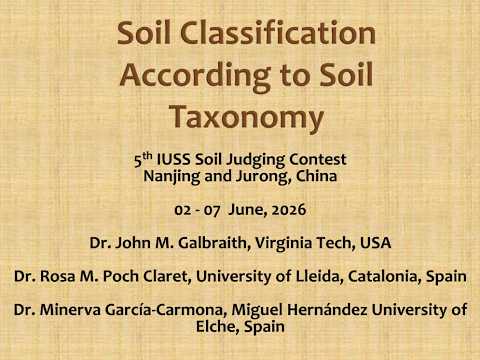
Soil Taxonomy Introduction and Simplified Key — Poch, Carmona, and Galbraith (Webinar slides)

*May be changed before the Soil Judging Contest in Nanjing

📚 Soil Description (Guidelines)

Manuals providing standardized procedures for describing soil profiles

Soil Taxonomy: NRCS Field Book
WRB: Annex 1 of the WRB Manual (p.159)

📚 Soil Taxonomy - Soil classification system

A Basic System of Soil Classification for Making and Interpreting Soil Surveys

Keys to Soil Taxonomy 2022
Illustrated Guide to ST (2015)
Related Materials
Spanish version of ST (2014)

📚 WRB - Soil classification system

World Reference Base for Soil Resources

WRB 2022 link
WRB page

🔄 Past contests materials

International Soil Judging past contests materials: Handbooks, scoresheets

Materials

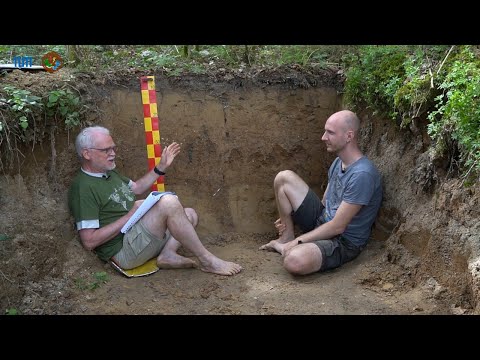
🎥 Training Videos

Explore various training resources and techniques.

Apply for next Soil Judging Contest (2026)

Join international soil judging events organized by IUSS. Check upcoming events and contact organizers for registration details.

Become an IUSS Member

IUSS membership provides access to global soil science resources, events, and networking. Visit iuss.org for membership info.

About IUSS and Soil Judging

IUSS, founded in 1924, promotes soil science worldwide. Initiated in USA, soil judging contests are key educational tools for hands-on learning. See more in our history section.

Benefits of Participation

Gain field skills, network with experts, and contribute to sustainable soil management. High employment rates for participants.

Please tell your friends

Spread the word about soil judging and its importance!

Learn more about soil classificaiton

Two international soil classification systems are widely used: the World Reference Base for Soil Resources (WRB) and the USDA Soil Taxonomy.

A Few Facts About soils

95
Food Production Relies on Soil
1000
Years to form 1 cm of soil
3
Major nutrients drive soil fertilization: NPK
33
Of agricultural land need to be recovered

Past Contests

Nanjing China 2026

5th International Soil Judging Contest
June 2-6, 2026. Nanjing and Zhenjiang, Jiangsu, China, as part of the 23rd World Congress of Soil Science.

23wcss page Contest recap & photos

Scotland 2022

4th International Soil Judging Contest
Near Stirling, Scotland, as part of the 22nd World Congress of Soil Science.

22wcss page

Brazil 2018

3rd International Soil Judging Contest
Seropédica, Rio de Janeiro, Brazil, as part of the 21st World Congress of Soil Science.

21wcss page

Hungary 2015

2nd International Soil Judging Contest
Gödöllő, Hungary, as part of the International Year of Soils.

Soil Judging 2015 page

Jeju Korea 2014

1st International Soil Judging Contest
Jeju Island, South Korea, as part of the 20th World Congress of Soil Science.

20wcss page SJ page SJ 2014 news

National and Regional Contests

Explore ongoing national and regional competitions.

View contests

Timeline of Soil Judging Contests

A short history of collegiate soil judging in the United States and its expansion to the international stage.

1940s–1950s

Land Judging emerges — a separate program, not soil judging

Land judging contests grew out of Future Farmers of America (FFA) and conservation district programs for high school students (grades 9–12). Although it predates collegiate soil judging and shares some field skills, land judging is organized by entirely different bodies — not by SSSA or ASA — and uses a simpler land-capability scorecard rather than full soil profile description. It is best understood as a parallel tradition, not an earlier stage of soil judging.

National Land & Range Judging Contest →

Late 1940s–1950s

First regional collegiate soil judging contests in the U.S.

Universities began running local and regional contests in which students described soil profiles in open pits — identifying horizons, classifying the soil, and interpreting it for land use. Accounts of exactly when and where the earliest contests were held vary; regional activity was well established in the Southeast and Midwest during the 1950s, and these contests became the foundation for a national event.

Archival report on soil judging history →

1961

First National Collegiate Soils Contest — Lexington, Kentucky

The regional contests converged into a national championship, sponsored by the Soil Science Society of America (SSSA) and the American Society of Agronomy (ASA), with USDA-NRCS soil scientists preparing and judging the official pit descriptions. The contest has been held every year since, hosted by a different university each spring; the 2021 edition was run virtually because of the COVID-19 pandemic.

National Collegiate Soils Contest →

1974

First published analysis of the collegiate soils contest

Post, Miller and Allen surveyed 198 student contestants and 73 instructors and coaches in the autumn of 1973 and published the results in the Journal of Agronomic Education. The paper set out the educational objectives of the contest and offered recommendations for improving it — the earliest formal reflection on soil judging as a teaching tool.

Post, Miller & Allen (1974) →

2000

Group (TEAM) judging introduced at the U.S. national contest

Building on an experiment by Terence Cooper in 1991, the national contest added a group component in which four or more students describe a pit collectively and submit a single, consensus scorecard. Later analysis of contest data showed that group scores exceeded individual scores on most sections of the card, and the format became a permanent part of the competition.

Cooper & Dolan (2003) →

2014

1st International Soil Judging Contest — Jeju, South Korea

Held alongside the 20th World Congress of Soil Science, the first international contest brought together national teams to describe volcanic soils and landscapes under a shared handbook, giving students their first chance to compare classification systems and field conventions across countries. Later editions followed in Hungary (2015), Brazil-Rio de Janeiro (2018) and Scotland-Glasgow (2022), and the 5th International Soil Judging Contest, held in Nanjing, China, in 2026, was the largest yet — 18 teams from 14 countries, and the first to require both Soil Taxonomy and the World Reference Base. The next contest will be held in Toronto in 2030.

SSSA report from Jeju →
Today

An international community of contests

Regional and national soil judging contests now run in numerous countries, with the U.S. national event regularly drawing more than twenty universities and several hundred participants. The International Soil Judging Contest continues to be held with each World Congress of Soil Science, keeping the field-skills tradition connected across national programmes.

Explore current contests →

Organizing Committee

Brian Needelman

Chair
University of Maryland - US

Brian
John Galbraith
Minerva García-Carmona

Vice Chairs

John Minerva
Simplified version of WRB and Soil Taxonomy

Co-chairs
Peter Schad
John Galbraith

Members
Chris Baxter, Erika Michéli, Andrew Sherfy, Márta Fuchs, Jaclyn Fiola, Richard Heck

Standard methodology

Co-chairs
Brian Needelman
Erika Michéli

Members
Márta Fuchs, Peter Schad, Amber Anderson, Fabricio Pedron, Daniel Saurette, John Galbraith, Rosa Poch

Communications

Co-chairs
Yuri Gelsleichter
Caleb Ocansey

Members
Jaclyn Fiola, Jorge Mataix Solera, Daniel Saurette, Fei Yang, Will Hernández

2026 China International Contest Committee

Co-chairs
John Galbraith
Fei Yang

Members
Biao Huang, Ganlin Zhang, Brian Needelman, Peter Schad, Daniel Saurette, Jinlong Dong, Xin Song

Get in touch